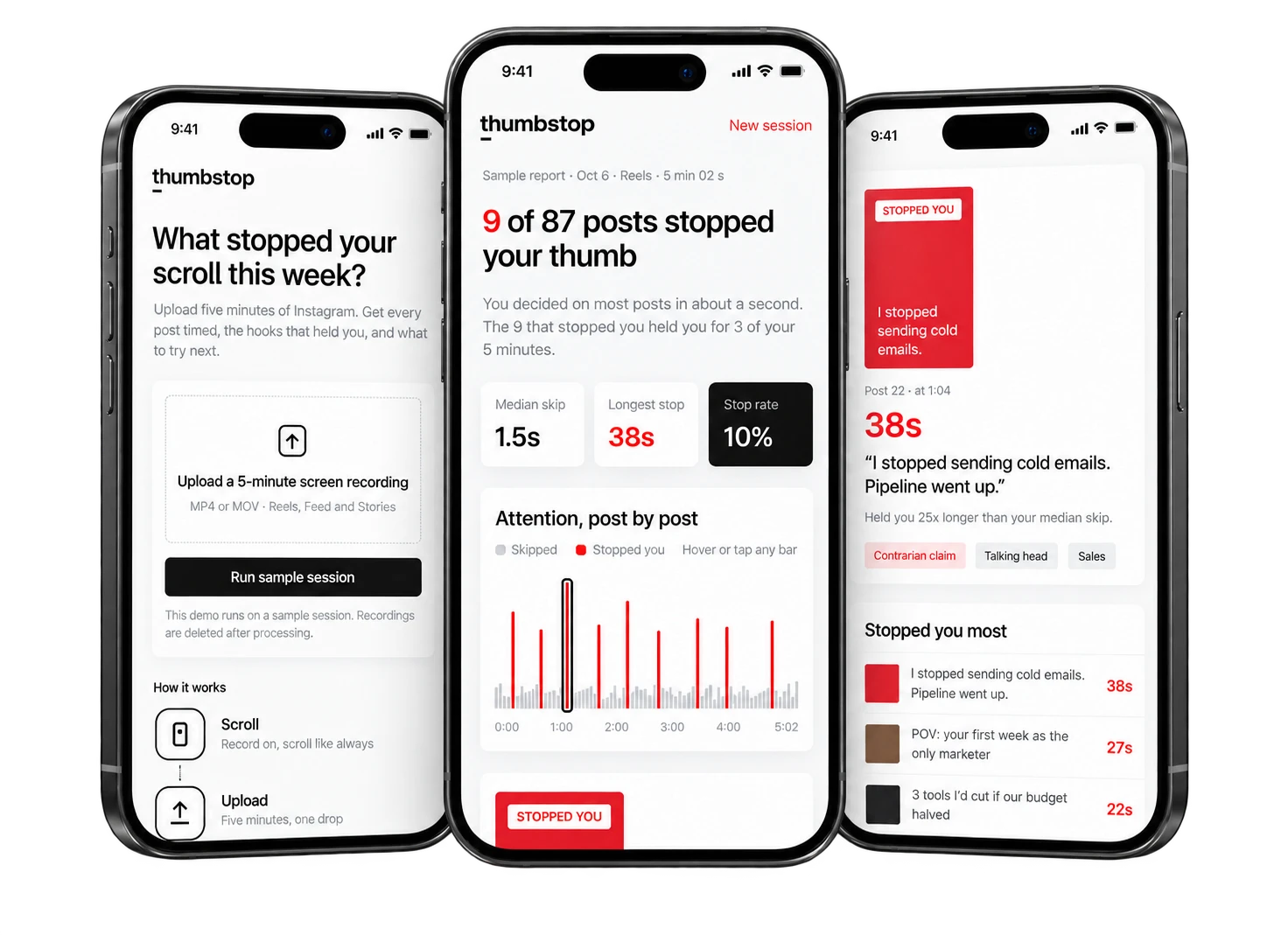
Every minute you spend scrolling trains your taste, which is why the hooks that work keep changing. For my own and client work, I built thumbstop - turning your autopiloted Instagram sessions into live insight on what's stopping the scroll this week
What actually makes something perform?
in the last few years I grew my own business to over 80K followers. I had a lot of GTM work with a heavy focus on organic social, writing posts, making videos and running paid creative on Meta. Across all of it, the question of the hook is always a prio: "does it stop the scroll in the first half-second?"
that answer is harder to find than most people think.
plenty of teams try to engineer a "working hook" from a template: open with a question, lead with a bold number, say "nobody talks about this." But the easier a hook is to summarize into a "playbook" and pass around, the faster it becomes a pattern and fatigues new audiences
what actually makes something perform is a mix of the substance, the visual, the sound, the vibe and trivial things nobody can name, like the angle of the shot. That's the art in organic content and why you can't fully engineer it
so what works keeps changing but the signal still exists - it lives in the half-second where your thumb decides to stop or keep going unconsciously, that's psychology doing the work. This is why good marketers consume content as part of the job: it trains an intuition they can't fully explain
big creative teams have people doing trend research full time. However a 6-person startup or a tiny DTC brand doesn't, so the hooks in their founder-led LinkedIn posts and Meta ads come from memory and gut feel
How thumbstop works
- 01ScrollRecord on, scroll like always
- 02UploadFive minutes, one drop
- 03AI reads itEvery pause and hook, tagged
- 04Quick insightsWhat stopped me, what to try
I do the first step and the rest happens while I get on with my day
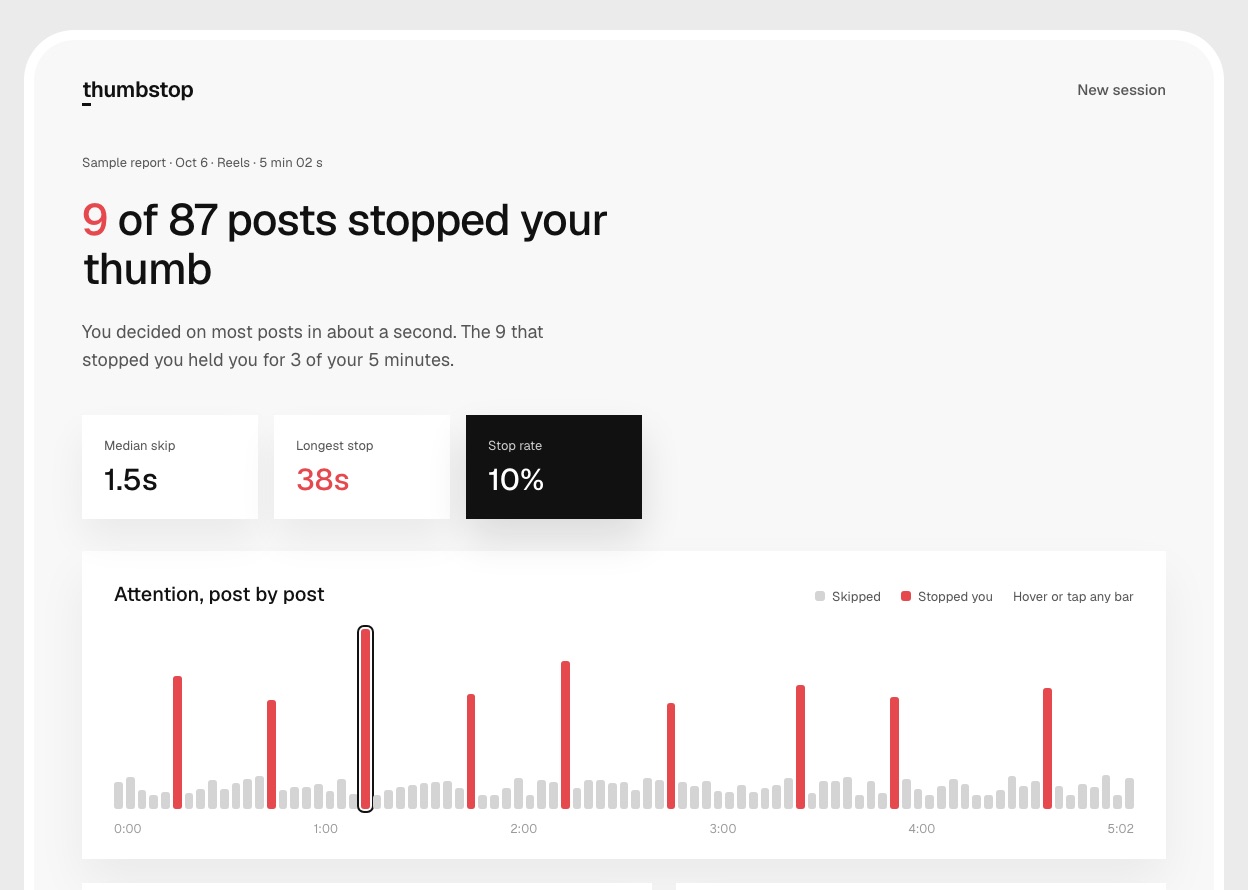
what then comes back is a one-page breakdown you can read on a phone in two minutes. The headline says what happened ("87 posts in 5 minutes, 9 stopped you"), and an attention strip shows every post as a bar, with skips as slivers and stops as spikes. And finally an executive view: the posts that stopped you, tagged by hook, format and topic, what they have in common
for a 6-person startup, here's what changes:
without a content team, their hooks come from memory, gut feel and an old swipe file. They test three ads picked on instinct, cut most of them, and lose an hour to "research" scrolling that leaves no notes behind
with thumbstop, five minutes of normal scrolling turns into a ranked list of what stopped them this week. Every ad variant starts from a pattern that is proven to earn attention this week, so less of the budget burns on testing creatives
similarly on Meta ads, a hook that stops more people tends to earn more clicks for the same spend, so a better starting point carries through every ad set they run
Concept & Product decisions
the concept came from wanting my social media sessions to stay organic instead of turning into "intentional audits."
today, small teams use three kinds of solutions:
- Trend dashboards, which aggregate data from millions of accounts and tell you what's rising. But they only see winners and the method is often times a black box, and a trend can be old by the time it shows up
- Ad libraries (for example, Meta's ad library or other tools like Foreplay), letting you save the ads you liked, but you're only able to capture what you notice consciously. They take dedicated effort and discipline to keep up
- Analytics platforms selling insights. Data is always useful but too much backward looking, meaning it's not the best to catch what's working right now
where it should live
I worked backward from where the scrolling actually happens: a phone, inside Instagram. A browser extension would've been easiest to build, but almost nobody scrolls Reels on a laptop. A background app would be zero effort but iOS doesn't let one app watch another. Another option is Instagram's data export, but anyone who's tried it knows how patchy that data is. Screen recording costs one tap and catches every frame, which is what I went with
why Instagram first
the teams I had in mind put their paid budget into Meta, so a hook that stops them on Instagram transfers straight into their next ad. Reels also makes the technical problem easier, since every swipe is a clean break between posts, and the feed and Stories let me test whether the approach holds across three ways of watching inside one app before taking on TikTok
what to measure
a like is a decision you made on purpose, so I rank by dwell time instead: how long a post held you before your thumb moved. Dwell is noisy (a notification can hold you too), so outliers can be dismissed and the results read as direction rather than verdict. The report gives weekly patterns instead of a permanent hook library, because hooks expire once they become formulas
where AI fits
splitting a recording into posts and timing each one is mechanical work, so that part stays rule-based. AI comes in where judgment is needed: reading the hook, labeling format and topic, and finding what the stops have in common. Keeping AI to that layer keeps the cost per report low and the output consistent from week to week
how I'd know it works
the number I care about is hook rate (three-second views divided by impressions) on ads built from a report, compared with ads built without one. If thumbstop-informed creative doesn't hold attention better, nothing else on this page matters
privacy
a recording can catch DMs and notifications, so each one is deleted after processing and only one frame per post is kept
Where it's at
right now it's Instagram only, with TikTok next. The demo runs on a sample session, so you can click through the whole flow without recording anything
subscribe to email list for occasional updates from me
You can unsubscribe anytime and I'll take you off.